DIY SlimeVR Tracker Prototype
I built one DIY SlimeVR tracker from individual electronics and an enclosure I printed from a credited community design. When I returned later, I got it powered, connected and through firmware/configuration, but never progressed to testing actual body tracking.
- Role
- Personal hardware prototype
- Status
Status: Prototype / Ongoing
- Period
- 2023 → revisited 2025
- Core hardware
- Wemos D1 Mini · BMI160
- Areas
- Electronics · Firmware configuration · Prototyping
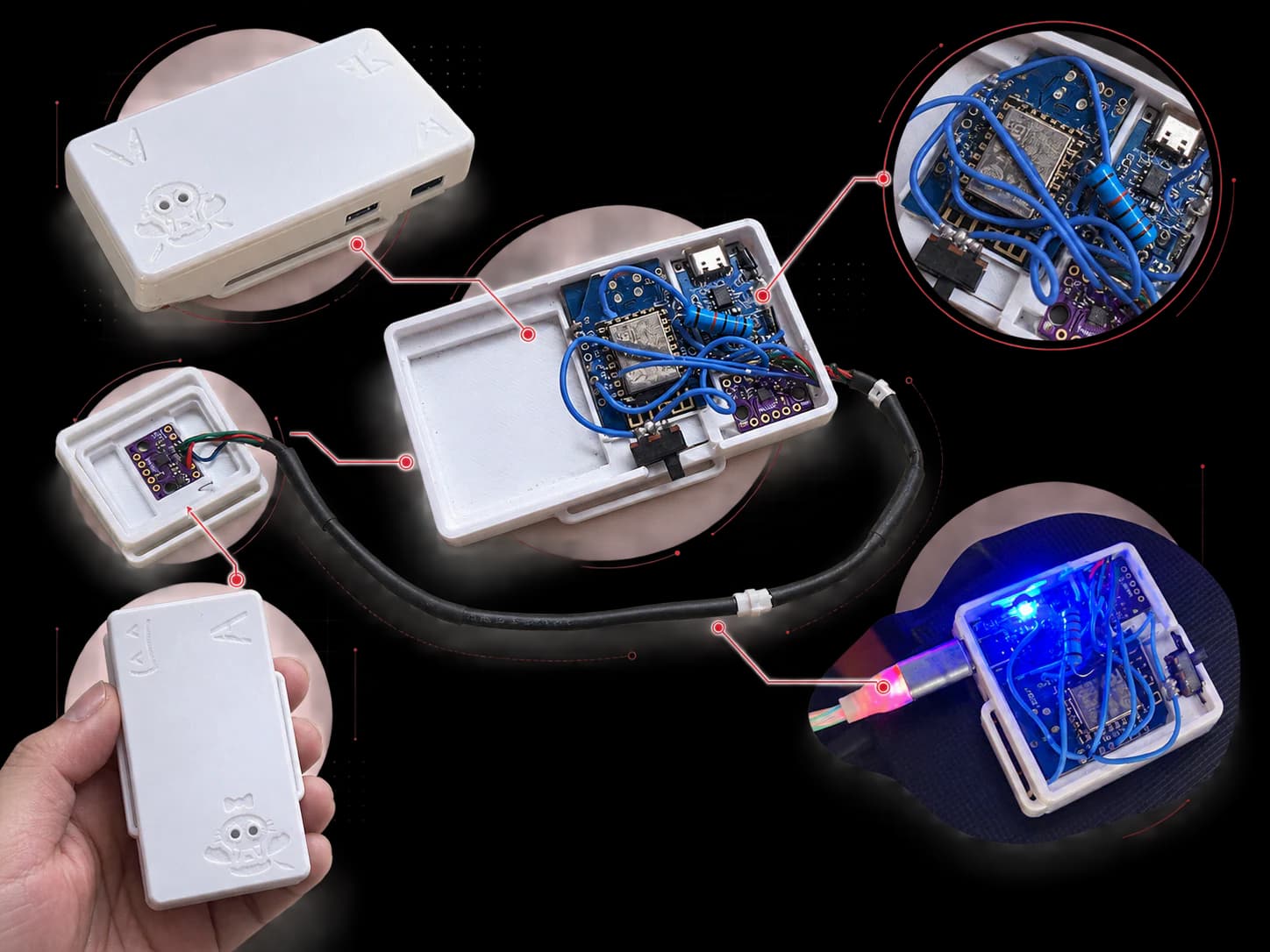
Enclosure: Minted Arcturus by Rosdayle, based on the original Arcturus design by Lixulia.
Physical prototype / honest endpoint
A tracker built from parts
This project started because I wanted full-body tracking for VR, but commercial systems were expensive. I bought enough parts for several trackers, then assembled and soldered the first one, integrated a cabled auxiliary sensor and fitted the electronics into an enclosure I printed from a community design.
The result is one real physical prototype rather than a finished tracker set. I eventually got the hardware powered and the firmware/configuration side working with the tracker connected, but I never progressed to testing actual body tracking.
Schematic → components → soldering → enclosure → power → firmware → Wi-Fi → IMU debugging → rework.
Why I wanted to build it
I wanted full-body tracking for VR, but commercial tracker systems were expensive, so building a DIY alternative seemed like a much more interesting way to get there.
I bought enough parts to build several trackers, but only completed the first prototype. I learned through schematics, documentation and community help as I turned that plan into a physical build.
2023 / parts roster
From schematic to components
The schematic and community build references gave me a starting point, but the work still had to become a physical object. The historical build centred on a Wemos D1 Mini, a BMI160 motion sensor and hand-soldered connections inside a compact enclosure.
I also experimented with a second BMI160 on a cabled extension using JST connectors. Battery and charging hardware formed the power subsystem, kept here at a high level rather than presented as a wiring guide.
- Controller
- Wemos D1 MiniESP8266-class board used in the historical prototype.
- Primary sensor
- BMI160 IMUThe main inertial sensor in the tracker body.
- Extension experiment
- Second BMI160An auxiliary sensor whose final working state is not established.
- Connection
- JST connectorUsed for the cabled extension arrangement.
- Construction
- Hand-soldered wiringA wired prototype assembled from individual electronics.
- Power
- Battery / charging hardwareDocumented only as a high-level subsystem.
June 2023 / physical assembly
Building the first tracker
In June 2023, the loose parts became a tracker body. I soldered the board and sensor connections, routed the extension cable and fitted the electronics into an enclosure I had 3D-printed myself.
By 29 June, the first tracker hardware was assembled but still without its battery. These photographs establish the physical build; they do not establish a complete powered system or working VR session at that point.
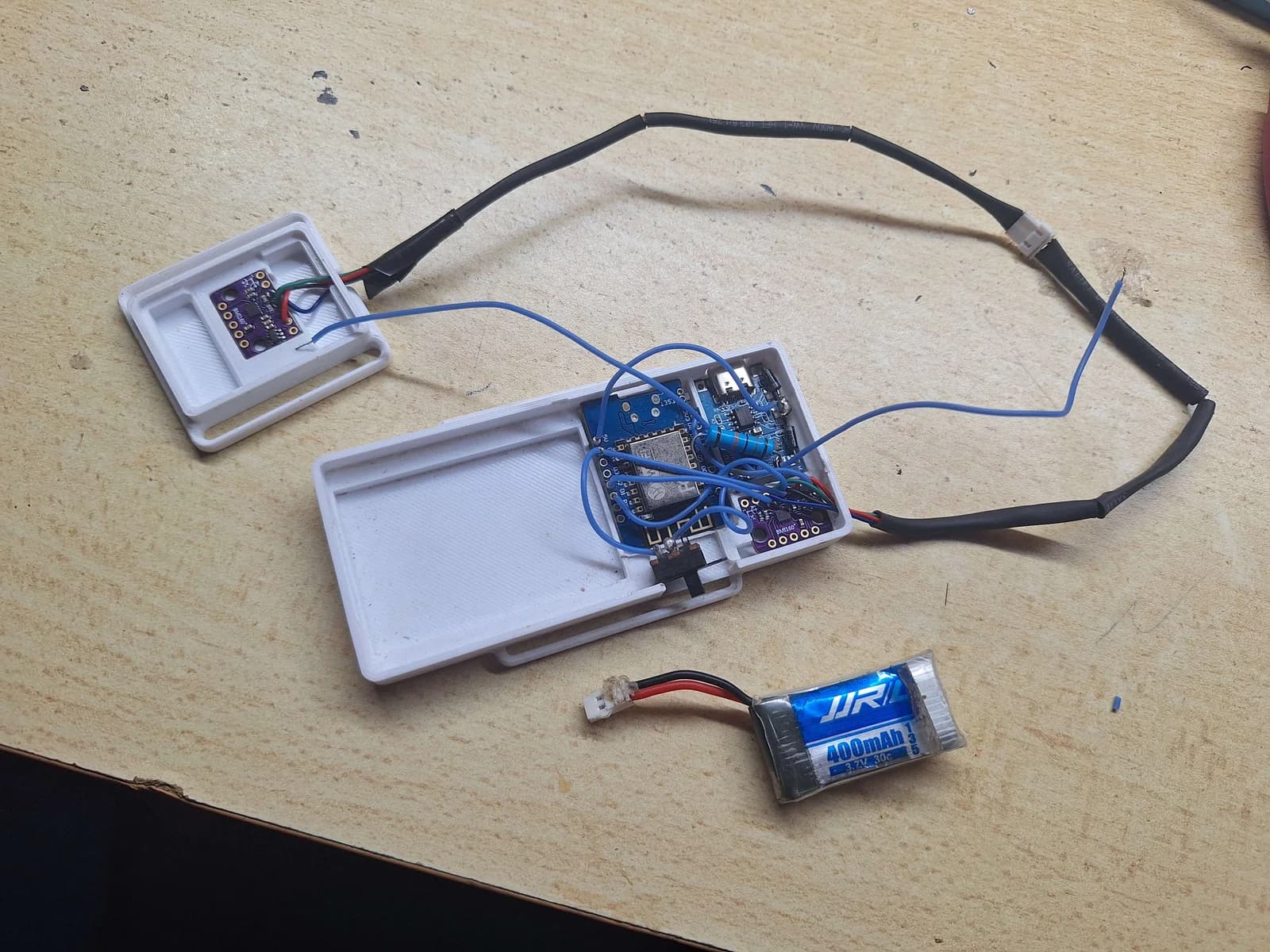
Inside the prototype: boards, hand-wired connections, an extension sensor and battery. 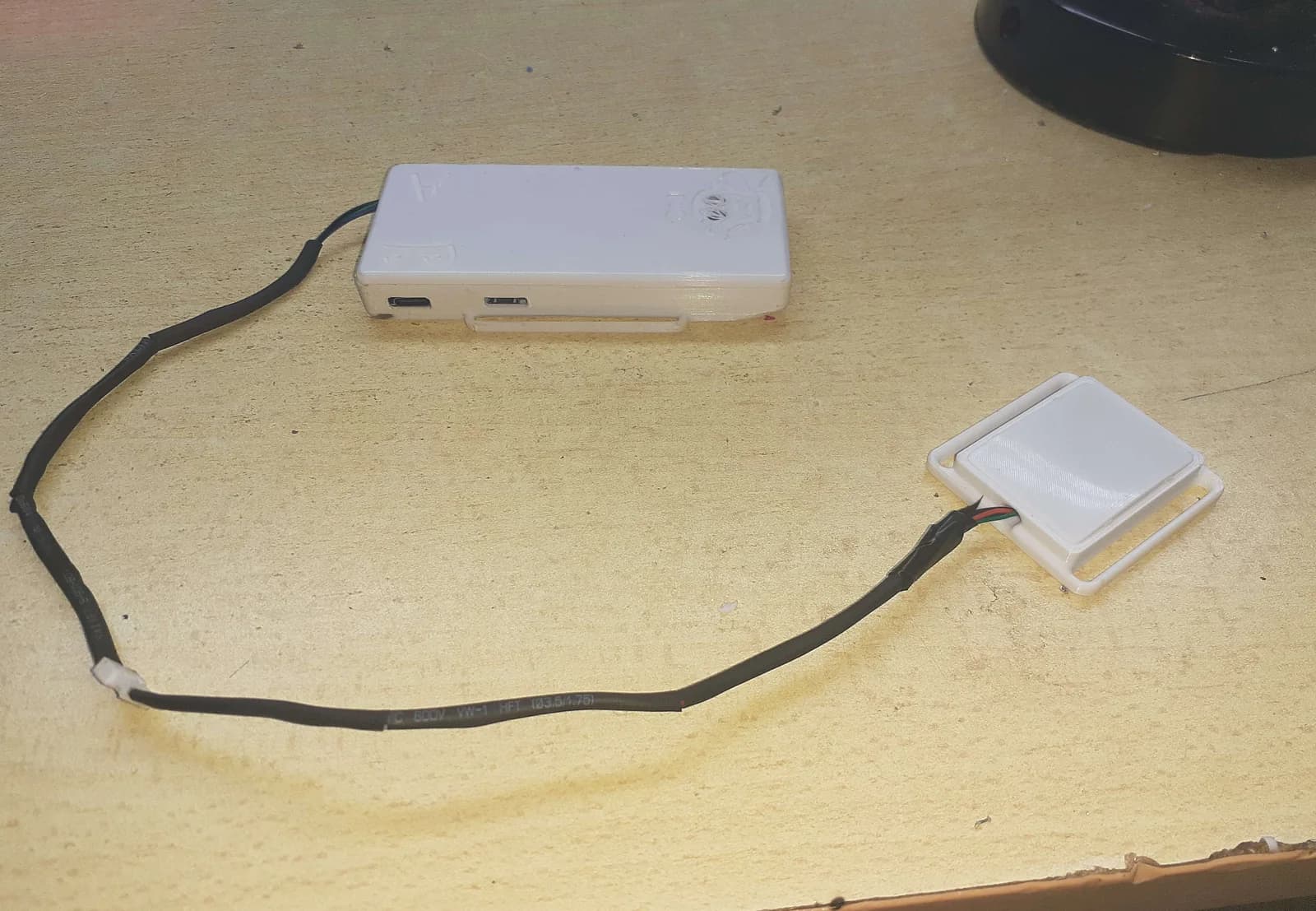
A printed enclosure, a sensor extension and a cable joining the two. Still a prototype.
Enclosure: Minted Arcturus by Rosdayle, based on the original Arcturus design by Lixulia.
Integration / attribution
A community-designed enclosure
I selected the community-designed Minted Arcturus enclosure and printed it myself. Integrating the board, sensor, power hardware and extension cable into that compact shell was part of my build; the enclosure design itself was community work.
Enclosure credit
Minted Arcturus by Rosdayle, based on the original Arcturus design by Lixulia.
I selected and 3D-printed this design, then integrated the electronics into it. The design credit remains with Rosdayle and Lixulia.
A real pause in the build
Then it sat unfinished
After completing the first physical tracker, I still needed a suitable LiPo battery and struggled to source one locally. The build sat on the shelf while I was still in school and schoolwork took priority.
I returned later to test the electronics and work through the firmware/configuration side. The additional tracker parts remained unassembled, and current projects now have higher priority.
- 2023
- One tracker assembled without its battery; parts for several more remained unassembled.
- 2025
- Prototype revisited, powered and taken through a working firmware/configuration connection; body tracking was never tested.
One physical tracker existed. Validation had to wait.
23 April 2025 / context rebuilt
Coming back in 2025
After a long break, I returned to the old prototype and had to reconstruct how its hardware and tooling fitted together. I powered it, connected the Wemos D1 Mini to a computer, and eventually got the firmware/configuration side working and the tracker connected.
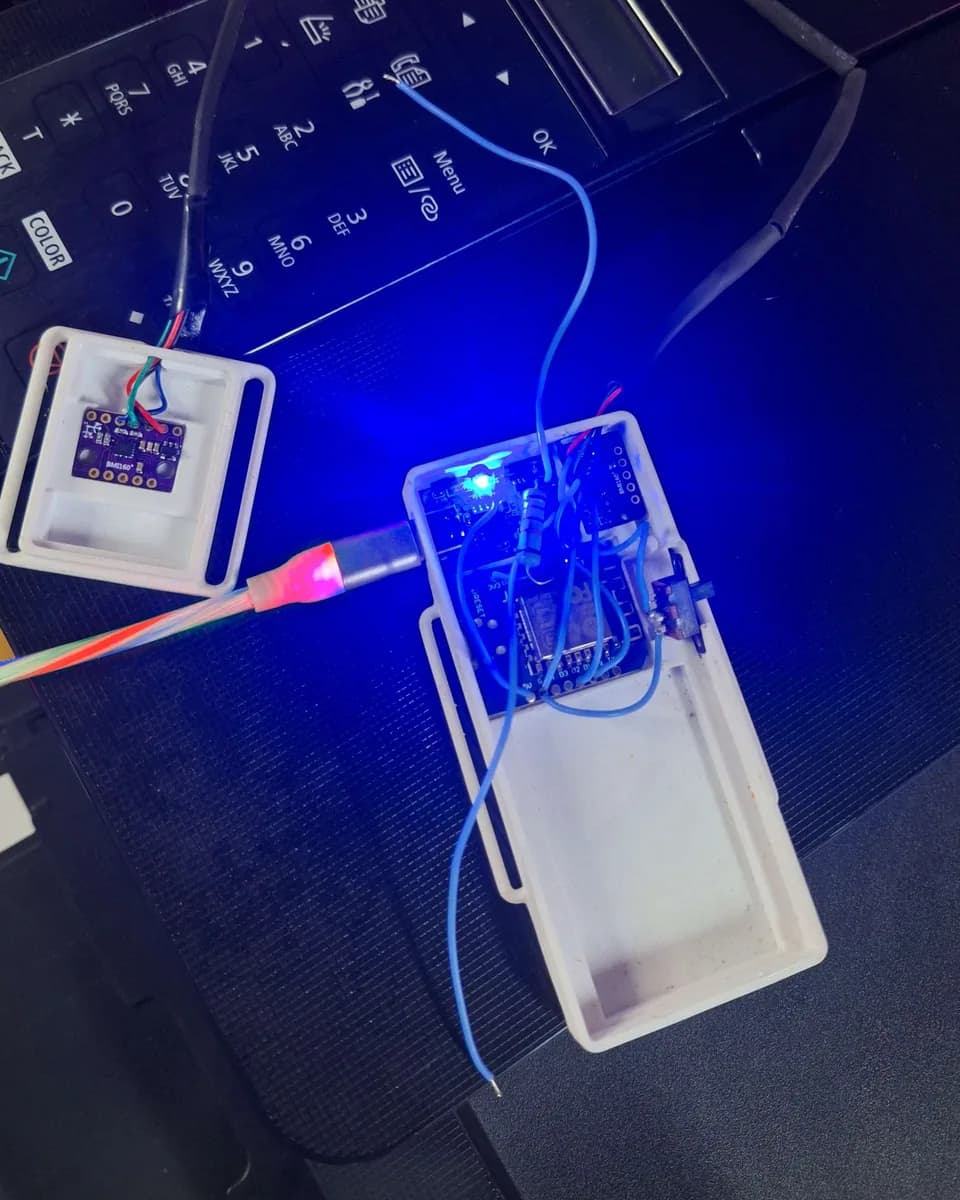
That was a meaningful step beyond the shelf-built hardware, but I never progressed to testing body tracking. The final frame below records power; it should not be read as evidence of tracking.

Observed state / layered validation
Power was only the first milestone
Getting an LED to turn on was exciting, but it only proved that part of the circuit had power. The next questions sat at different layers: whether the computer connection worked, whether firmware could be configured, whether Wi-Fi was correct and whether the IMUs were actually being detected.
I eventually got the firmware/configuration side working and the tracker connected. I also investigated Wi-Fi, IMU detection and calibration, but the exact final sensor and calibration state is not established, and I never progressed to testing body tracking.
- PowerObserved — the prototype powered on.
- Serial / USBConnected — computer link established.
- FirmwareWorking configuration state reached.
- Wi-FiConfiguration trouble investigated.
- IMU detectionInvestigated; final state unverified.
- CalibrationAttempted; completion not proven.
Observation → physical rework
Debugging the sensor path
The IMU behaviour did not match expectations, so I moved back from software-facing symptoms to the physical sensor connection. I investigated detection, re-soldered part of the connection and compared the tracker’s behaviour again.
The LED behaviour changed after that rework. That was useful evidence, not a final diagnosis: the exact final state of the primary and auxiliary BMI160s, and of calibration, is not established.
- 01 / Observe
- Sensor behaviour did not match expectations.
- 02 / Isolate
- IMU detection became the focus of the investigation.
- 03 / Rework
- Part of the physical sensor connection was re-soldered.
- 04 / Compare
- LED behaviour changed after the hardware rework.
- 05 / Continue
- The auxiliary BMI160 remained under investigation.
Unresolved endpoint
Changed behaviour was useful evidence, not proof of a fix.
The record supports a bounded debugging pass across electronics and firmware tooling. The exact final sensor and calibration state is still unknown, and body tracking was never tested.
Prototype status / written plainly
What was demonstrated — and what was not
A prototype can be meaningful without pretending that every layer reached completion. The evidence supports physical assembly, power, a working firmware/configuration connection, troubleshooting and rework; it does not support any claim about body-tracking performance because I never tested it.
Demonstrated in the prototype
- One physical tracker assembled and still retained
- Enclosure personally printed from the credited community design
- Parts bought for several more trackers, but left unassembled
- Hand-soldered electronics and cabled extension
- Prototype powered on
- Firmware/configuration working and tracker connected
- Sensor troubleshooting and physical rework undertaken
Outside the evidence
- A complete tracker set
- Any completed body-tracking test
- Tracking accuracy, drift or session performance
- Exact final primary or auxiliary BMI160 state
- Completed calibration
- Battery runtime or production reliability
Current guidance / separate from the historical build
The ecosystem moved on
The hardware above records what I built in 2023 and revisited in 2025. Current SlimeVR guidance changes how the same project should be approached today; it does not rewrite the historical build.
- Wemos D1 Mini
- Still documented as a common DIY controller option.
- BMI160
- Now treated as a legacy, poor choice for a new build; newer IMUs are favoured.
- Construction
- PCB-based builds are now preferred over fully wired construction.
- Extensions
- New extension arrangements are discouraged, with tighter ESP8266 secondary-IMU limits.
Revision note
Historical evidence is not current build advice.
Any future iteration should re-evaluate the controller, sensor and extension arrangement against current SlimeVR guidance rather than reproduce the 2023 design unchanged.
Current status
What the prototype taught me
One of the hardest parts was learning to read the schematic and turn it into something physical. The IMUs and the wires I was soldering were tiny, so even simple connections required much more precision than I expected.
Re-soldering a small sensor connection and then seeing the LED behaviour change made that lesson concrete: in hardware, a connection can look almost right and still stop the rest of the system from behaving properly.
- A schematic still has to be translated into a precise physical build.
- Tiny components and wires leave very little margin for an imperfect connection.
- Power, configuration and actual tracking are separate validation milestones.
- Physical rework can be part of software-adjacent debugging.
PROTOTYPE / ONGOING
Current state
One physical prototype remains.
I still own the original tracker. The additional trackers were never assembled, and current projects have higher priority, so the project is unfinished but resumable rather than in active development.